As explained in our discussion on time, we experienced vibrations associated with the Hum noise, which reduced the gravity felt on my body. This experience prompted further research, revealing that the vibration counteracted the effects of time. For those unfamiliar with the Hum and our observations, please visit the Contact page, which includes a link to our research. It is important to note that the vibration requires additional investigation, and our theory cannot be brought to fruition without this further work. When we refer to the Hum, we imply the discussion is associated with the time vibrations.
To monitor Hum infrasound from Earth's magma flows, we should establish an array of microphones in likely active areas, such as Auckland, and eventually extend them over the Canterbury earthquake region, possibly as far as Otago and Marlborough. These microphones should be placed in relatively quiet locations close to where the hearer is located. The Hum sound is also linked to other phenomena, making time a multifaceted subject worthy of exploration. Therefore, research must consider individual reports of hearing the Hum infrasound, any associated experiences, and track the sound's movement.
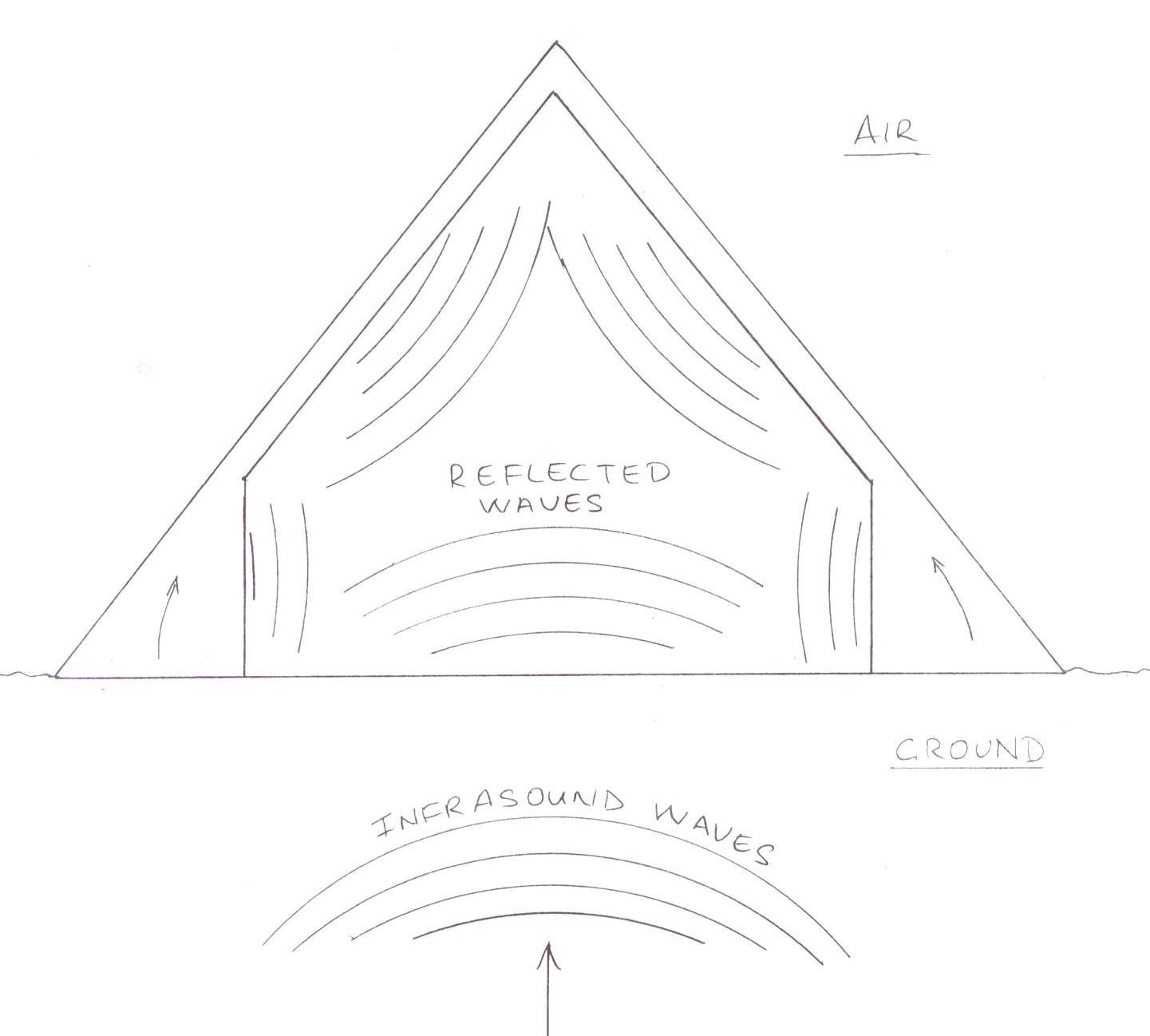
Our preferred method involves using a microphone housed within a hollow concrete four sided pyramid (see Figure 1). The pyramid's hollow interior will allow sound to penetrate from below and through the walls while excluding external noise. This pyramidal shape is crucial because the infrasound will reflect within the pyramid, amplifying the sound for the microphone. An alternative method is to embed the microphone in the ground, but this approach will be less effective due to inadequate amplification. The microphones should be capable of capturing sound from 0Hz upwards and operate continuously for over 12 months to identify magma movement between various microphones. This will help us record fluctuations in sound at different sites and note the varying arrival times, indicating the direction of magma flow, especially in Auckland.
The choosing of the Auckland area is based on a larger population from which to select hearers, two universities that could assist in the research, and our personal experiences with intriguing phenomena in the area. The selection of suitable sites within Auckland will depend on the locations of hearers and whether they form an appropriately sized grid pattern. Ideally, the distance between sites should align with the Hum's estimated travel speed of about 6 meters per minute. This speed suggests that sites should be spaced at the most 8 kilometres apart, corresponding to a day's travel time for the phenomenon. However, some sites may also relate to notable effects observed in the past.
Some of the participants we have contacted in the past may not be available, so we may need to advertise the research to recruit new individuals. There is no guarantee that we will receive responses, as it largely depends on how relevant the experience has become. We may experience periods of low activity, which could delay the research due to insufficient data points. It is estimated that 7% of the population hear the Hum and about 3% feel a vibration, and the number of people experiencing a loss of weight or levitation is even lower at one person per century.
When bringing new participants into this study, it is essential to develop a vetting system to ensure that these individuals can be trusted. A reliable participant working with the researcher is crucial for this project, providing the necessary reliability and control. Privacy is also a significant concern, as any publication of names may lead to feelings of insecurity or social ostracism. Many highly trained professionals who experience the Hum, may prefer not to get involved due to a reasonable fear of being labelled as 'hearing things or voices,' even though no voices are involved.
Fortunately, those affected are determined to resolve their issues, so we hope to face minimal resistance. They have three options: enduring sleep deprivation, selling their homes, moving location, or assisting us before they feel compelled to relocate.
The main issue is the researcher may not have shared any of the Hum experiences. This creates an awkward and challenging situation, as the researcher may struggle to gather helpful insights to verify that the data they are recording corresponds to what the participant is reporting. Unlike typical research projects led by qualified experts, ours is directed by the experiences of unqualified hearers, with limited knowledge of infrasound. Frustrations can be expected, as participating hearers will be untrained, and some may be untrainable. This will lead to significant challenges for the researchers wanting scientific data to match the recordings. Additionally, the phenomenon may not always occur at high intensity, which could force the researcher to work part-time. Therefore, the researchers must be aware of the proposed theory and the benefits it offers, and be patient and focused.
An effective recording system must be developed so that participants can use it daily. This research requires commitment from everyone involved. Participants must report their experiences during the night, often in low light or darkness. No one wants to fully wake up and write reports under such conditions. A simple button console designed for use in the dark would be beneficial. The type of information we require may include the following:
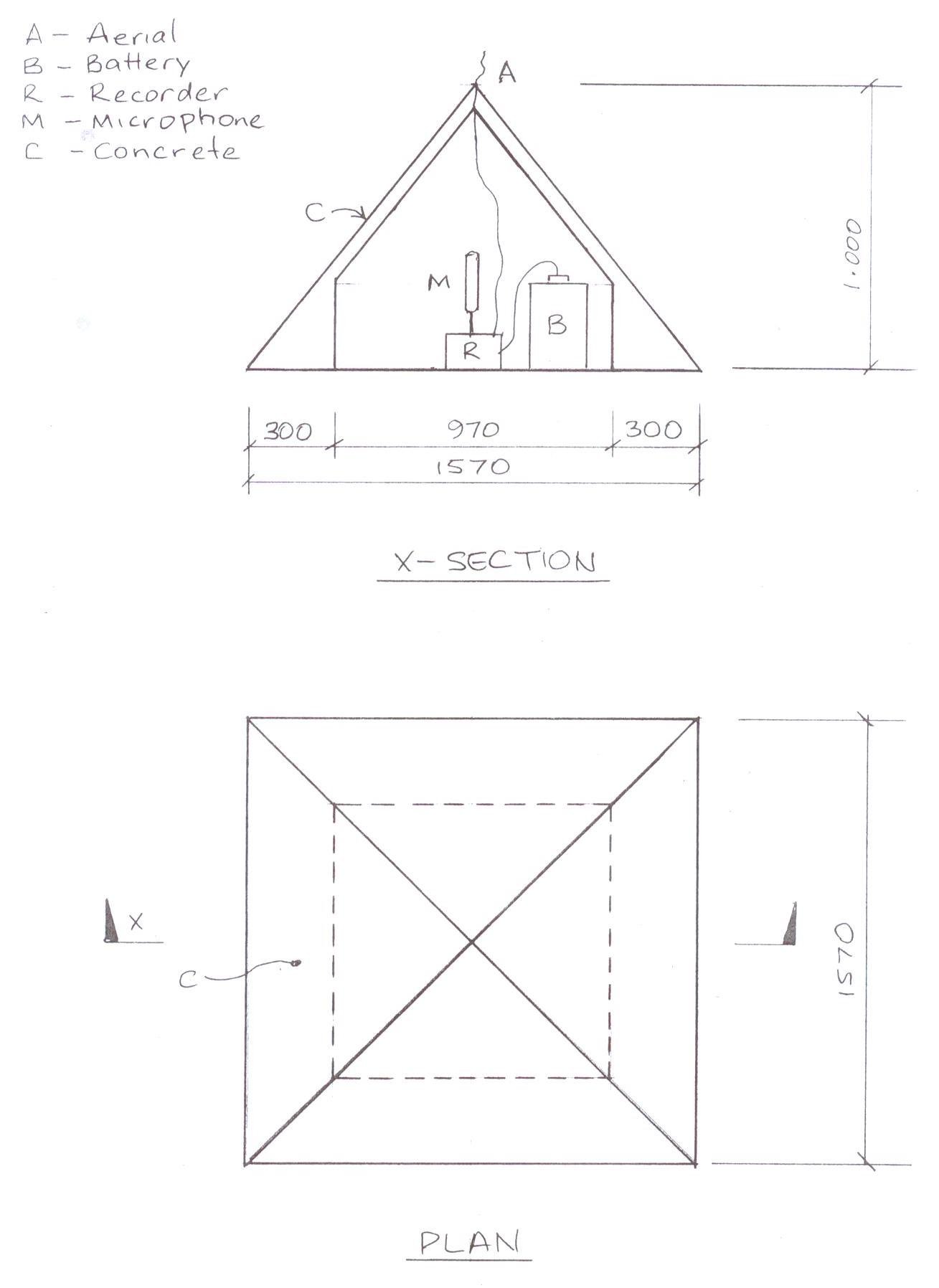
The equipment needed for each pyramid (See Figure 2) are a microphone recorder capturing the digital pattern, hard-disk to store it on , an easily charged battery, and an aerial to transmit at regular intervals. The pyramid is expected to be about three-quarters of a ton in weight, 1m tall, (the other drawing dimensions are in millimetres.) and must be delivered using a small crane on the back of a truck. The setup will use a jacking point on the side of the pyramid, and by tilting the pyramid on its side will make it possible to access the microphone or battery.
The hearers' training will need to be done in a room or chamber so that they are subjected to various infrasound frequencies using several computer-generated frequencies and past Hum recordings. Because some of this research is subjective, careful training is important. Our experience shows that many sufferers miss many aspects, because many new things bombard them. They note the big stuff and miss subtle things because they haven't carefully listened to what they're experiencing. Like any education, students must be led through many experiences until they are fully trained.
We will not be respected if we are not seen as knowledgeable by the hearers. Therefore, we will need to impress upon them that we are the experts in this field and that we have been studying this phenomenon for many years, and they must listen and learn. The last thing we want is a hearer who ignores our methodology and does not listen. We found this problem annoying when we explained to someone, we had never met, that we had been experiencing the Hum for 20 years, and the cause of this sound was unrelated to something in the human made environment. Yet they persisted with their local source thinking.
We must add non-hearer experiences, as this will also generate useful information. People suffer from infrasound without knowing what it is, and as we recalled from one elderly lady, who was interviewed on TV a day or so after the Christchurch earthquake, she said she was shaking and considered it either the quake or fear that was causing it. It was more likely an infrasound vibration caused her shaking.
The listening will evolve into other studies, and by embarking on the Hum, we may see more of the phenomenon it causes, especially on the brain. More on this can be found on our Hum website. Also, we found that when researching the Hum, our first theoretical approach changed because of the facts that were discovered. More refined knowledge led to the connection to Time. This website is the first step, and when the public understands our concepts, we expect they will collectively shake their heads, to clear them, and wonder how they had missed such obvious things for so long.
As we continue to consider this research, more things get caught in its net. As an example, an observation that requires testing is the concept that the vibration created by the movement of magma might affect genetics. Darwin and David Attenborough noted the diversity of animal species on the Galapagos Islands, when the only route to the island was by air or water via storms or currents. The islands' volcanic origin is not an obvious influencer, yet with a magma source 60 miles across and reaching deep within the mantle, vibrations will be present. It would be worth pondering whether the magmatic infrasound sped up the process of evolution and, therefore, the diversity of the limited species in the area. Testing this idea would likely be time-consuming unless a methodology could be found to reduce the observation period required.
At this point, go to the Links page. This page widens the discussion and includes seeing into future time.